How Israel benefits from Gaza destruction
TEHRAN – Hamas has warned that Zionist regime’s violations are preventing the truce from advancing to its crucial second phase.
The Palestinian resistance movement pointed out at least 738 documented breaches since the truce took effect on October 10, and Hamas says these ongoing violations block progress on phase two measures.
Most notably in the second phase is the Israeli military withdrawal from occupied areas behind the so-called “yellow line” and the approval for heavy machinery to enter Gaza to begin clearing debris.
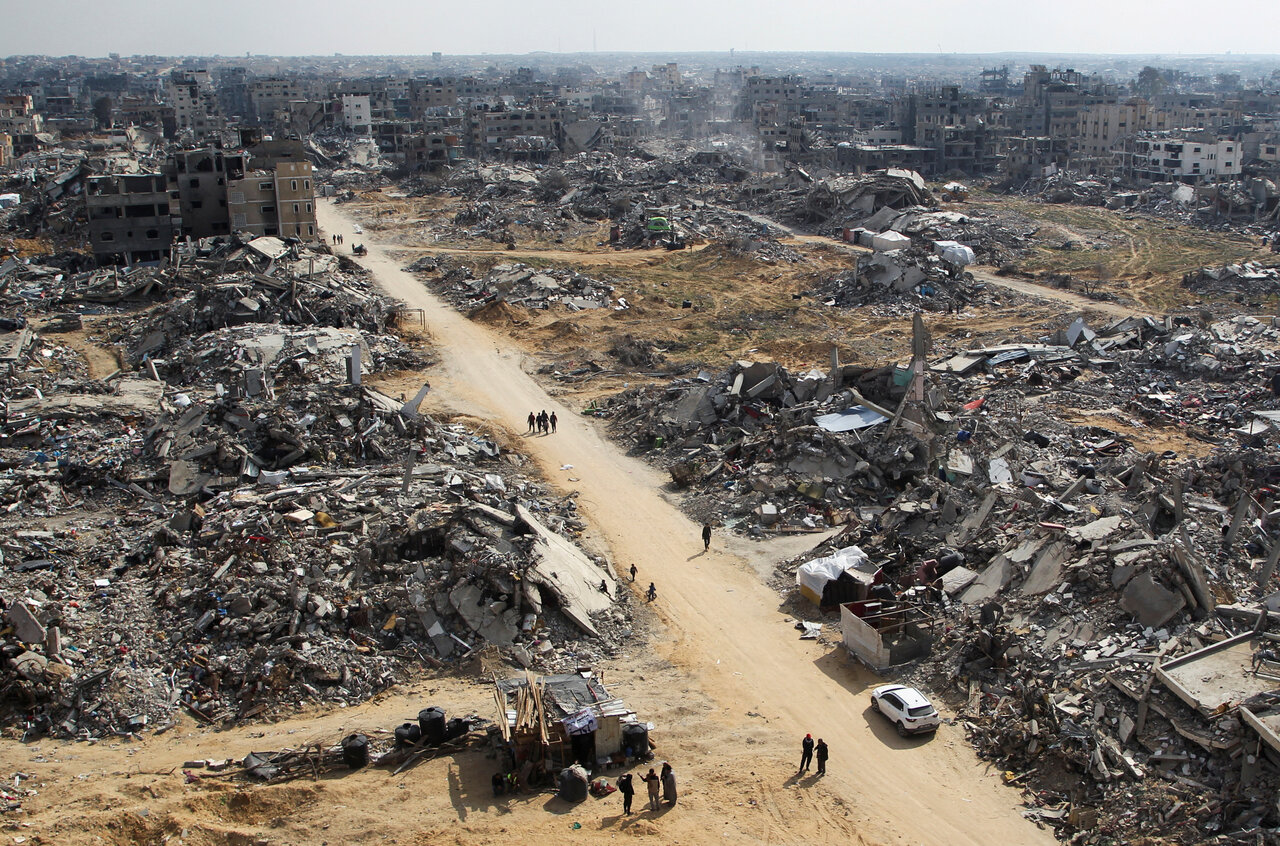
Gaza today lies under an estimated 68 million tons of rubble, more debris than most cities could clear in a decade. United Nations satellite assessments show that more than 123,000 buildings have been destroyed and another 75,000 damaged, affecting roughly 81 percent of all structures.
The weight of the rubble is equivalent to about 186 Empire State buildings. Spread across Manhattan, it would average more than 200 pounds per square foot.
Before reconstruction can even begin, Gaza faces at least five years of debris removal, more likely seven, according to the UN Development Programme (UNDP).
The debris field is also laced with unexploded bombs, rockets and artillery shells, and Palestinian health authorities estimate that around 10,000 bodies remain trapped beneath the ruins.
The Israeli regime’s control over border crossings means large-scale clearance cannot start until it approves the entry of heavy machinery needed to remove rubble and neutralize remaining explosives.
Gaza currently has only a small number of functioning excavators, forklifts, dump trucks and just one operational crusher for recycling debris.
The UN has requested authorization to bring in hundreds of additional machines, yet no agreement has been reached. Clearance alone is expected to cost more than a billion dollars, and full reconstruction is estimated at around $70 billion.
The UN Office for the Coordination of Humanitarian Affairs (OCHA) reports that nearly 850,000 people living in 761 displacement sites across the Gaza Strip are at the greatest risk of flooding this week.
The regime’s daily violations of the ceasefire appear aimed at delaying the truce’s crucial second phase for its own strategic advantage as well as the collective punishment of more than two million people.
Palestinians in Gaza see the devastation and the delays in allowing reconstruction equipment as part of a system that keeps daily life suspended between emergency and deprivation.
With infrastructure shattered, families cannot return to their neighborhoods, and essential services recover only slowly. Daily life remains centered around survival rather than rebuilding a functioning economy or stable social institutions. Entire generations face prolonged educational disruption, loss of income, and the erosion of community networks.
Public calls by several Zionist ministers for “voluntary migration” from Gaza, along with comments by U.S. President Donald Trump about turning Gaza into a “Riviera,” have fueled deep fears among Palestinians.
They interpret these ethnic cleansing remarks as implying the removal of Gaza’s population. These proposals evoke the memory of 1948 and are widely rejected as attempts to engineer another Nakba. The scale of destruction and the barriers to reconstruction appear to Palestinians as part of a broader effort to push them off their land by making life unlivable.
Israel’s attempts to delay the transition to phase two also carry risks for the Zionist regime. A devastated Gaza fosters deep bitterness while increasing the likelihood of renewed armed resistance. It also heightens international condemnation of the Israeli regime’s ongoing genocide along with its global isolation.
Leave a Comment