Trump’s psychological warfare over Venezuela’s skies

TEHRAN – The United States has intensified its pressure on Venezuela by sending two Navy F/A 18 fighter jets over the Gulf of Venezuela. Although the Pentagon described the maneuver as a routine training flight, the timing and proximity to Venezuelan airspace made it appear far from routine.
For Caracas, this was another sign of Washington’s growing military presence in the region. The flights came after more than three months of deadly boat strikes in the Caribbean and Pacific, operations that have killed nearly 90 people and raised serious questions about legality and accountability. Venezuelan Foreign Minister Yvan Gil has condemned these actions as part of an unprecedented campaign of “psychological warfare,” arguing that Washington is now combining economic, military, and media power to destabilize Venezuela after sanctions failed to achieve their goals.
Analysts see these moves as part of a broader strategy. Hossein Hooshmand, a U.S. affairs analyst, told the Tehran Times: “America’s movements in the region and the deployment of military forces — combined with Venezuela’s economic crisis and its possession of the world’s largest oil reserves — make Washington’s intent to pursue regime change unmistakable.”
U.S. affairs analyst Hossein Hooshmand tells Tehran Times: “America’s movements in the region and the deployment of military forces — combined with Venezuela’s economic crisis and its possession of the world’s largest oil reserves — make Washington’s intent to pursue regime change unmistakable.”He explained that the first stage of this strategy involves “psychological operations” and limited strikes on selected targets to pressure President Nicolás Maduro into fleeing. “Reports about offering him asylum and providing guarantees from Washington fit into this plan,” Hooshmand noted. But if Maduro refuses to leave, he warned, “the U.S. will escalate military attacks inside Venezuelan territory.”
Hooshmand emphasized that Washington is not seeking a full-scale war or ground operations like in Afghanistan or Iraq — lessons have been learned from those conflicts. Yet, he added, “this does not mean the U.S. will overlook Venezuela’s vast oil wealth and the enormous profits it promises for American oil companies, especially given Venezuela’s poor economic conditions.”
These military actions and threats mark a shift from earlier reliance on economic sanctions, which failed to achieve Washington’s objectives. Sanctions were intended to isolate Venezuela and weaken its government, but instead, they prompted Caracas to strengthen ties with alternative partners. With sanctions proving insufficient, the Trump administration has turned to direct military pressure, presenting its campaign as a fight against drug cartels. Yet the lack of Congressional authorization and the high civilian toll undermine this narrative, suggesting that the real objective lies elsewhere.
The broader strategy becomes clearer when viewed through the lens of the recently published National Security Strategy by the Trump administration. This document openly revives the Monroe Doctrine, signaling that Latin America is once again Washington’s primary sphere of influence. The so-called “Trump Corollary” elevates the Western Hemisphere above the Middle East as America’s top foreign policy priority. It ties U.S. prosperity and security to maintaining dominance in the region, explicitly aiming to block China and Russia from gaining footholds. Venezuela, with its vast oil reserves and strategic Caribbean coastline, is therefore treated as a central battleground in this renewed doctrine.
The contradictions in U.S. policy reveal the underlying logic. While Maduro is branded a “narco dictator,” Trump pardoned former Honduran president Juan Orlando Hernández, convicted of helping move tons of cocaine into the United States. The difference is not about law or morality but about loyalty. Hernández remains useful to Washington, while Maduro insists on independence. This double standard shows that obedience is rewarded, while defiance is punished, exposing the true principle guiding U.S. actions in the region.
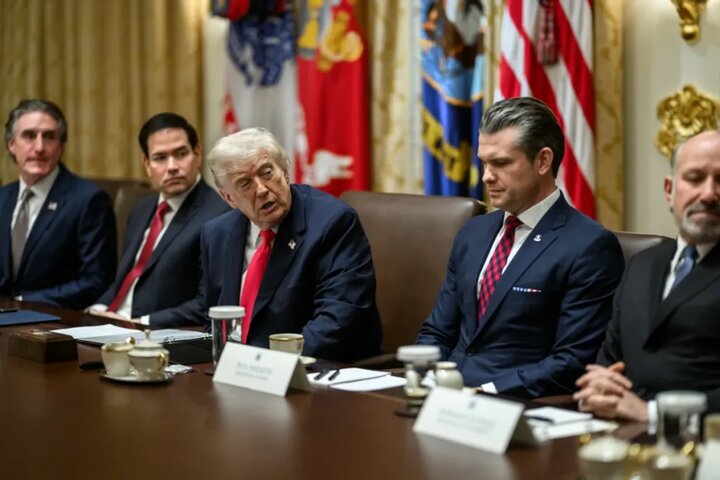
President Trump has formally revived the 182-year-old Monroe Doctrine, introducing a “Trump Corollary” in his administration’s new National Security Strategy to reassert U.S. dominance in the Western Hemisphere.
Faced with sanctions and military threats, Venezuela has turned to China and Russia for support. Beijing has invested heavily in oil, mining, and infrastructure, providing financial lifelines and technology. Moscow has supplied military equipment and diplomatic backing, helping Caracas resist isolation. These partnerships are not only about survival; they represent a different model of international relations, one based on sovereignty and mutual benefit rather than subordination. In this way, Venezuela demonstrates that Latin America has alternatives to Washington’s dominance.
The current campaign against Venezuela is not an isolated case. It fits into a long history of U.S. intervention in Latin America. In Chile in 1973, Washington supported the coup that overthrew President Salvador Allende, paving the way for Augusto Pinochet’s dictatorship. In Nicaragua during the 1980s, the U.S. funded and armed the Contras against the Sandinista government, despite international condemnation. In Panama in 1989, American forces invaded to remove Manuel Noriega, an operation that killed hundreds of civilians. Each of these interventions was justified in the language of security or democracy, but in practice, they served to protect U.S. strategic and economic interests. Venezuela today is simply the latest stage in this pattern.
The latest military flights, combined with the rhetoric of the National Security Strategy and the analysis of experts like Hooshmand, illustrate that Trump’s Venezuela policy is not truly about drugs or democracy. It is about control of resources and blocking rivals. By reviving the Monroe Doctrine, Washington signals its willingness to use force, sanctions, and psychological pressure to maintain dominance. Yet Latin America today is more connected to the world than ever before. China has become the region’s second-largest trading partner, and Russia continues to expand its presence. These developments suggest that Washington’s heavy-handed approach may ultimately weaken its influence rather than strengthen it.
Presently, if Washington continues to rely on intimidation and unilateralism, it risks repeating the mistakes of Chile, Nicaragua, and Panama, where intervention brought instability and resentment rather than lasting influence. In a multipolar world, Latin America’s future may depend on rejecting U.S. dominance and embracing new alliances that promise independence and prosperity.
Leave a Comment