Pompeo’s wishful thinking: engineered collapse in Iran
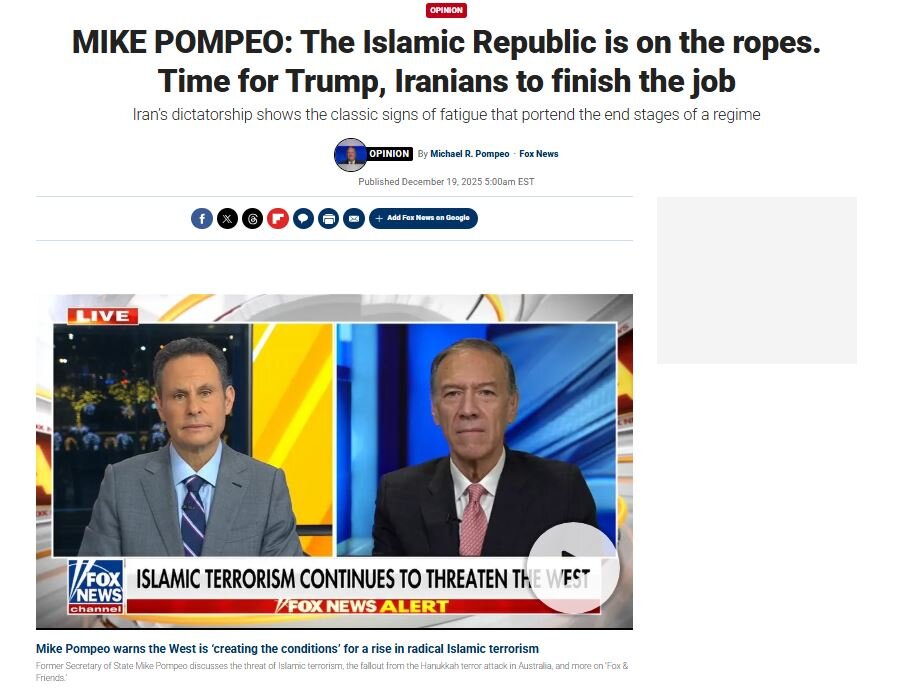
TEHRAN – Mike Pompeo’s recent Fox News op-ed, titled “The Islamic Republic is on the ropes. Time for Trump, Iranians to finish the job,” deserves a careful response — not because it offers some type of analysis, but because it reveals a worldview that treats a sovereign nation as a political project to be engineered from abroad.
Pompeo writes as if Iran were an object — a problem set to be “managed,” “degraded,” or “finished.” That formulation contradicts every civilized principle of state sovereignty and self-determination the West claims to uphold. Pompeo simultaneously insists that the United States must not impose “regime change” while arguing the case for an external policy engineered precisely to bring about that outcome. This hypocrisy is the defining pattern of a policy that privileges geopolitical objectives over the rights and agency of ordinary people.
History teaches the danger of this approach. When outsiders decide to “make” outcomes in other countries, the result is often instability rather than democracy. The U.S. invasion of Iraq in 2003—justified by strategic rhetoric and promises of liberation—produced long-term chaos, state collapse, and regional spillover that persist two decades on. Libya’s 2011 intervention likewise removed an autocrat but left a fragmented polity where militias and civil war took root. These are decisive empirical counterexamples to the idea that foreign pressure reliably produces orderly transitions to liberal democracy.
Pompeo’s narrative assumes that Iranians will welcome a plan designed abroad and executed under the banner of “maximum pressure.” This misunderstands popular sentiment inside Iran. Iranians have repeatedly shown they prize independence and dignity. Popular movements in Iran are often aimed at state policies, corruption, or economic mismanagement — not at handing authority to foreign powers or exile groups. During times of crisis or external threat, mobilization around national sovereignty and opposition to foreign interference increases. This was exemplified during the 12-day war in June where Iranian people showed brave solidarity, surprising many external figures who believed a “regime change” would definingly ensue.
Equally important is the question of legitimacy. Western endorsement from afar does not translate into domestic legitimacy inside Iran. All movements and foreign-based opposition figures lack the organic support on the ground necessary to govern. Attempts to substitute foreign recognition for internal legitimacy have a long record of failure; they are remembered domestically as tainted or even treasonous. The political communities that endure in Iran do so because they have roots inside society — not because Washington recognizes them. Pompeo’s insistence that a ready-made democratic blueprint exists, therefore, reads more like wishful projection than political reality.
On the matter of Iran’s economic and social difficulties, Pompeo is selective in his facts. It is undeniable that Iran faces serious economic challenges and environmental stresses. But context matters: a large portion of Iran’s economic distress is the direct result of sanctions and economic coercion from the West. Sanctions are not neutral instruments; they are policies with predictable social effects. International economic analyses and public-health assessments have repeatedly shown how sweeping financial restrictions depress growth, raise prices, and harm ordinary citizens’ welfare. When assessing the causes of hardship, it is misleading to treat these effects as purely domestic failures rather than the outcome of deliberate external sanctions.
Pompeo also raises the issue of water scarcity and frames it as an internal governance failure unique to Iran. The facts tell a different story: water stress is a global challenge exacerbated by climate change, mismanagement, and infrastructure deficits across many countries.
On nuclear issues, Pompeo’s claim that Iran’s nuclear program has been “severely decimated” must be read against the record. Iran’s scientific and industrial base is indigenous, dispersed, and difficult to eliminate simply by targeting facilities. Bold assertions about destroyed capabilities often serve strategic narratives more than technical truths.
Finally, the argument that the United States should “shape the environment” so that collapse, when it comes, results in stability, is both dangerous and naïve. You cannot plan for a desirable outcome from afar by squeezing a society economically and politically, then pretend the aftermath will unfold like a boardroom strategy session. External pressure tends to harden politics, empower security establishments, and shrink the space for the civil society that democratic transitions require. If the goal is a peaceful, democratic Iran, the most reliable path is one that enlarges channels for meaningful domestic political development — not one that treats Iranians as a problem set to be solved by sanctions, covert measures, or the elevation of exile leaders.
Pompeo’s article is a reminder that the language of liberation can be used to disguise coercion. The better path — and the only one consonant with respect for national self-determination — is to enable Iranians, not try to replace them. Those who truly stand with the people of Iran should make their commitment by ending policies that punish everyday life, by facilitating the free flow of ideas and assistance, and by recognizing that durable change must be homegrown. As for Pompeo’s wishful claims, history suggests that such ambitions are translated into policy at heavy cost — and are often carried forward by their proponents long after the facts on the ground tell another story.
Leave a Comment