The strategy of avoiding excitement in foreign policy
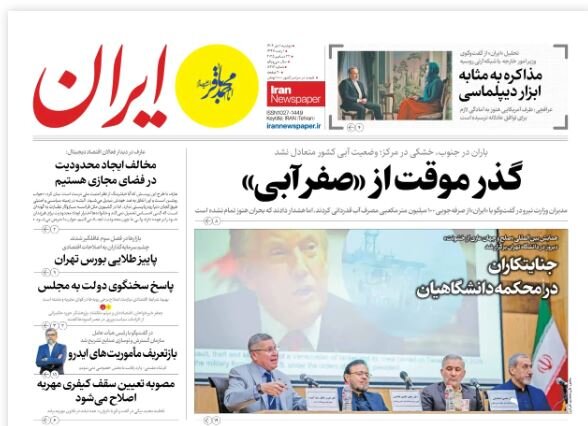
TEHRAN - The Iran newspaper covered the Foreign Minister’s interview with Russia’s RT channel.
The recent interview of Seyyed Abbas Araghchi with can be seen as a clear reflection of the recalibration of the Islamic Republic of Iran’s nuclear and diplomatic policy in the post-war context. From the Foreign Minister’s perspective, the repetition of U.S. position shows that Washington is still not prepared for a fair agreement. On this basis, one can understand why the current foreign policy strategy avoids rushing into negotiations whose outcomes are already predetermined. In the interview, Araghchi emphasized that negotiations can only be reactivated when the other side concludes that dialogue is a substitute for pressure, not a cover for it. His remarks on the nature of equal and rational negotiations confirm that Iran’s foreign policy has adopted a realistic approach toward diplomatic tools. This means that in the current period, Iran’s Foreign Ministry will focus on reducing political costs to avoid excitement in the field of foreign policy.
Kayhan: Western-oriented groups have fallen behind realities
Kayhan devoted its editorial to Western media’s acknowledgment of the decline of the “U.S.-centered” approach. The paper argues that the explicit admissions of respected American and European publications, leading scholars of international relations, and even Western officials all point to an undeniable reality: the “U.S.-centered” order is collapsing. This collapse is not the product of rival propaganda but the result of America’s own behavior toward its closest allies. The key question, however, is this: if today even Europe, Japan, South Korea, and other American allies are seeking a “Plan B,” how is it that within Iran there still exists a faction that presents “aligning with America” as the country’s salvation? The Western-oriented current in Iran has for years reduced foreign policy to a simplistic formula: “If we come to terms with America, everything will be fixed.” Yet America is not even reliable for its allies, let alone for an independent country unwilling to become a follower. What is happening in Europe today offers a clear picture of the future of trust in Washington. This is the same Europe that Iran’s Western-oriented faction once introduced as the model of “political rationality.”
Farhikhtegan: Tehran must make efforts to regain its lost share
Farhikhtegan wrote about Pezeshkian’s recent trip to Central Asia and his diplomatic meetings in Kazakhstan and Turkmenistan: This visit, going beyond ordinary diplomatic protocol, reflects Tehran’s recognition of a bitter reality and a strategic necessity during the transitional phase of the international system. If Tehran fails to secure its position in Central Asia at this critical juncture, it will be permanently excluded from the region’s equations, reduced to merely watching its rivals occupy its historic backyard. This region is transforming—from a peripheral zone into the heart of global geoeconomic developments. Putin’s presence, Trump’s perspective, Israel’s activities, and Turkey’s maneuvering all signal the importance of this new “great game.” Iran has both the potential and the entitlement to be a key player here, but this entitlement can only be realized through pragmatic diplomacy, a focus on shared economic interests, and avoidance of empty slogans. Each day of delay in activating transit and economic capacities means further advances by rivals and a tightening of the security encirclement against Iran. Now is the time for Tehran, with firm resolve, to revive its civilizational heritage using modern instruments of power—before the gates of Central Asia close to it.
Ham Mihan: If Iran finds a middle ground, Europe and US will welcome it
Ham Mihan, in a commentary, examined current signals regarding negotiations, nuclear issues, and possible scenarios. Quoting Rahman Ghahremanpour, senior analyst of foreign policy and international relations, it wrote: The International Atomic Energy Agency (IAEA) is more subject to political developments than the other way around. Our negotiations are not contingent upon agreement with the Agency. Relations have always had ups and downs under different circumstances, but whenever Iran and the U.S. have placed political will behind negotiations, the Agency has not been able—or cannot—stand in the way. Iran wants to begin a new round of talks, provided that—as Mr. Araghchi recently stated—the U.S. accepts Iran’s enrichment condition, after which Iran would proceed with the Cairo agreement. If the other side refuses concessions, experience shows that Iran usually seeks a middle-ground solution to prevent the Agency from entering a tense atmosphere with Iran. It should be noted that the other side has not been sensitive about the Agency, and whenever Iran has cooperated, it has been welcomed.
Leave a Comment