‘Our defensive capabilities not open for talks’: Iran’s foreign ministry
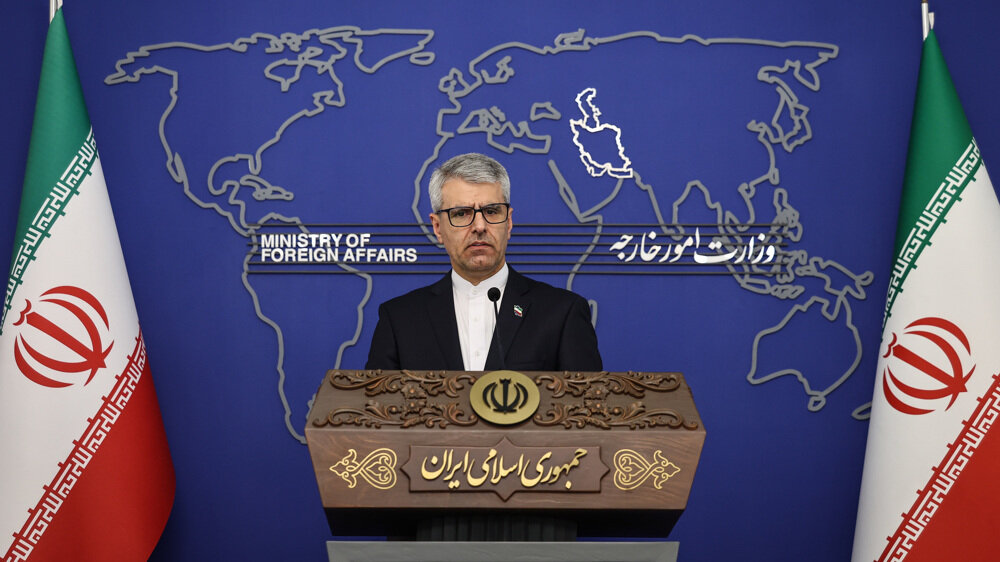
TEHRAN – Iran’s Foreign Ministry spokesman Esmaeil Baqaei used his weekly press briefing on Monday to reiterate Tehran’s positions on regional conflicts, international diplomacy, and national defense, strongly criticizing Israel and the United States while rejecting Western accusations against Iran.
Addressing issues ranging from Gaza and Ukraine to Iran’s missile program and relations with Russia, Baqaei emphasized deterrence, dialogue, and resistance to what he described as double standards and unlawful pressure in international affairs.
‘Our defensive capabilities are not open for negotiation’
Spokesman for Iran’s Foreign Ministry, opened the weekly briefing emphasizing the country’s defensive posture. “The country’s defensive capabilities, designed to deter any aggressors from contemplating an attack on Iran, are not a matter for negotiation,” he said.
Baqaei highlighted that Iran’s missile program is strictly defensive and underscored the double standard in Western media, which portrays Iran’s defensive programs as threats while supplying weapons to Israel.
On June 13, Israel launched an unprovoked war against Iran, assassinating many high-ranking military commanders, nuclear scientists, and ordinary civilians.
More than a week later, the United States also entered the war by bombing three Iranian nuclear sites in a grave violation of the United Nations Charter, international law, and the Nuclear Non-Proliferation Treaty (NPT).
In response, the Iranian Armed Forces targeted strategic sites across the occupied territories as well as the al-Udeid air base in Qatar, the largest American military base in West Asia.
On June 24, Iran, through its successful retaliatory operations against both the Israeli regime and the US, managed to impose a halt to the illegal assault.
‘The region faces the ongoing crimes of the Zionist regime’
Addressing regional developments, Baqaei stressed: “Our region continues to face a persistent problem, which is nothing other than the ongoing crimes of the Zionist regime.” He warned that the situation in Gaza should not distract from abuses occurring in the West Bank, including inhumane treatment, arrests, and killings, which he said are “examples of crimes against humanity.” He called for international accountability to curb the lawlessness of the Zionist regime.
Regarding resistance in the region, Baqaei stated: “The regime’s activities amount to nothing but mischief and killing. This regime does not consider itself a legitimate part of the region.” He added that resistance is “present in the heart of the community and the people of the region,” reflecting the ongoing presence of occupation and oppression.
Reports from Gaza since the ceasefire’s implementation describe a territory still in collapse. Hospitals are overwhelmed. Aid is sporadic and insufficient. Entire neighborhoods remain uninhabitable. The blockade continues to choke off fuel, medicine, and reconstruction materials. None of this is resolved by the ceasefire, because the ceasefire was never designed to resolve it. It was designed to manage it.
‘Ukraine conflict must be resolved through dialogue’
Responding to European claims that Iran, Belarus, and North Korea are supplying Russia, Baqaei dismissed the accusations as “nothing but a repeated claim.”
He reiterated Iran’s stance that problems must be resolved through dialogue and criticized European countries for NATO’s hostile actions, which he said have endangered Europe’s security.
‘We have a strategic partnership with Russia’
Baqaei addressed the recent visit of Araqchi to Moscow and meetings with Russian officials, emphasizing that ‘Iran-Russia relations are extensive’ and that both sides are committed to utilizing the strategic partnership to its full capacity.
He described the signed documents as a continuation of longstanding consultations on bilateral and international issues.
Iran and Russia are both subject to illegal Western sanctions. They have over the past years strengthened their relations in various fields.
Russia has repeatedly defended Iran’s right to a peaceful nuclear energy program.
‘Without Gen. Soleimani’s bravery, ISIS terror would have expanded’
On regional security and terrorism, Baqaei recalled the role of late Lieutenant General Qassem Soleimani in curbing ISIS: “Without his bravery, ISIS would have expanded its terrorism in the region.”
He criticized attacks in Syria and other regional interventions as creating conditions favorable to terrorism, holding the U.S. and Israel responsible for the consequences.
Soleimani was assassinated by a targeted drone strike on January 3, 2020, in Baghdad, Iraq, along with Abu Mahdi al-Muhandis, an Iraqi paramilitary leader and former chief of staff of the Popular Mobilization Forces.
‘The U.S. is complicit in Israel’s crimes’
Baqaei criticized U.S. policy toward Israel: “Israel has long been a burden on the U.S., imposing the costs of its crimes. The U.S. is complicit in Israel’s actions.”
He also addressed public perception, arguing that repeated U.S. and Israeli actions are increasingly recognized as costly and harmful by global opinion.
‘If Canada is sincere, it should oppose sanctions on Iran’
On international resolutions targeting Iran, Baqaei criticized Canada’s role, calling the process political and biased. “Canada, if it truly cares about human rights, should first oppose the unjust sanctions against the Iranian people and stop supporting the regime in committing crimes,” he said.
Canada’s Foreign Minister Anita Anand announced on last Monday that Ottawa had imposed sanctions on four senior Iranian officials, accusing them of involvement in “gross and systematic human rights violations.”
‘Seizure of Chinese tanker is a serious threat to international peace’
Finally, Baqaei condemned U.S. actions in the Caribbean, including the seizure of a Chinese tanker, describing them as “a serious threat to international peace and stability.” He warned that Iran would respond decisively to any aggression against its interests.
The Trump administration claims that Venezuela is using oil, its main resource, to finance “narcoterrorism.”
Since September, the US military has also conducted a series of airstrikes on alleged drugtrafficking boats in the Caribbean Sea and the eastern Pacific Ocean.
Critics have questioned the legality of these attacks, which have killed more than 100 people.
Leave a Comment