Israel has launched cognitive warfare on Iran
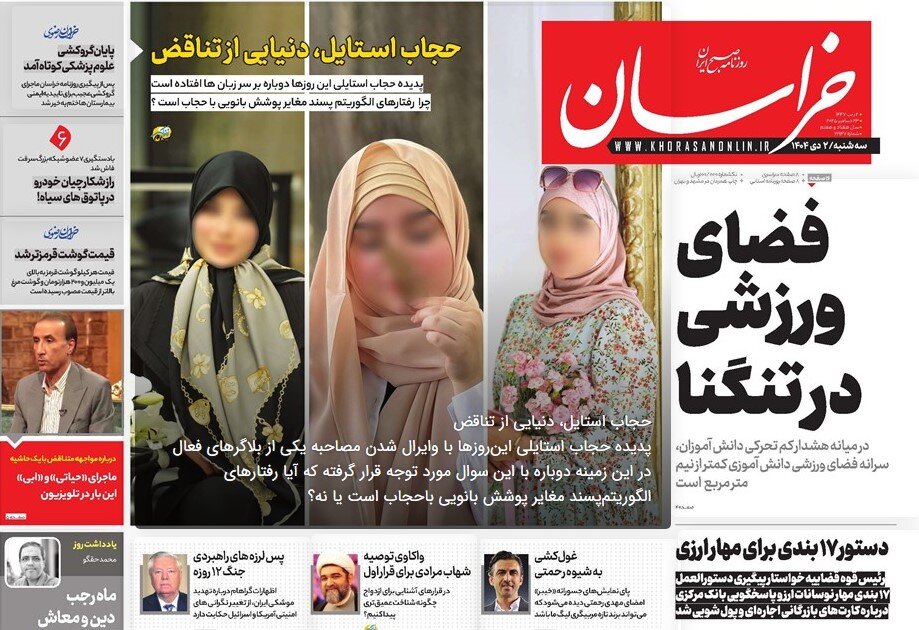
TEHRAN - The Khorasan newspaper analyzed recent media narratives surrounding Iran’s missile and nuclear programs, arguing that these portrayals are less about reflecting realities and more about serving psychological and media functions. This emphasis aims to generate anxiety, instill a sense of threat, and influence public opinion in Iran and across the region.
Tel Aviv’s focus on Iran as a supposed danger is described as a cover for the real crisis in Gaza and a strategy to preserve Netanyahu’s domestic credibility. This tactic, the article notes, operates not only within the occupied territories but also internationally. Demonizing Iran provides Israel with a pretext to secure U.S. political backing and reduce global pressure against itself. Bluffing about Iran is framed as part of a broader psychological operation, revealing Netanyahu’s desperation in the face of accumulated failures and his political and security constraints. In reality, neither Iran nor the international community is swayed by this psychological warfare. Iran’s national cohesion, the article concludes, enables it to neutralize such media and threats, while its recent military and defense achievements send a clear deterrent message to its adversaries.
Donya-e-Eqtesad: A full copy of the Shahed drone
Donya-e-Eqtesad commented on the U.S. development of the “Lucas” drone, saying it is essentially a full copy of Iran’s Shahed-136. The paper argues that this low-cost, unmanned offensive system, currently being developed by the U.S. Marine Corps, mirrors the Iranian model. Among drone powers, Iran is described as the most capable with its inexpensive and effective Shahed suicide drones dominating battlefields. The system is already proving its capabilities and, without doubt, will become a key weapon for the U.S. Marines. It is likely, the article suggests, that this drone will appear over battlefields in Europe, the Middle East, the Indo-Pacific, and perhaps even Latin America. The commentary accuses the U.S. of stealing Iranian military technology, stressing that Iran’s equipment is far more sophisticated than Washington portrays to ordinary Americans. This raises the question of what other advanced weapons Iran possesses that could pose a genuine threat to U.S. forces and their allies in the Middle East.
Resalat: Iran’s geopolitical position is unique
Resalat, in an interview with Abbas Moghtadaei, vice-chairman of the National Security and Foreign Policy Committee of Parliament, examined Iran’s geopolitical role in global equations. Moghtadaei argued that Iran is one of the few countries with a distinguished position in terms of geography and geopolitics. He listed several advantages: Iran borders 15 countries in a highly significant and strategic region. Its islands and coastal cities enable extensive connections across land and sea. Iran’s unique political structure can serve as an inspiration to nations across different continents. Its anti-unilateralist approach, strengthened by participation in the Shanghai Cooperation Organization and BRICS, has elevated Iran’s standing. Moghtadaei predicted that in the coming years, the Islamic Republic will be more powerful than ever, with a broader and more developed role. Following the 12-day war, Iran’s political, defensive, and security strength—alongside social cohesion and influence on public opinion—became more evident than ever, offering opportunities for maximum leverage and success.
Shargh: Continuity of objectives and change of methods
Shargh reflected on Iran and the larger Middle East in the U.S. National Security Strategy. The paper noted that the strategy targets Iran with indirect containment and maximum pressure, delegating implementation to regional allies. It argued that America’s geostrategic goals in the Middle East remain unchanged: control of energy resources, guaranteeing Israel’s security, containing Iran, and preventing Chinese and Russian influence. The key shift, however, is that the U.S. no longer seeks to be the primary actor, but rather a grand designer and coordinator. On the ground—from Yemen to Syria and the Caucasus—proxy actors such as Israel, the UAE, Turkey, and affiliated militias are tasked with executing this strategy. Thus, the new National Security Strategy does not signal retreat but rather a redefinition of America’s presence in the region: indirect, flexible, and based on a network of proxy allies. In response, the Axis of Resistance must adapt by recognizing these transformations, identifying new arenas of political engagement, and rebuilding its counter-strategy on the foundations of smart deterrence, independent decision-making, and deepened strategic depth in West Asia.
Leave a Comment