The imposed ‘peace’ on Gaza
Gaza won’t become part of an American project or a lifeline for failed politicians or dealmakers
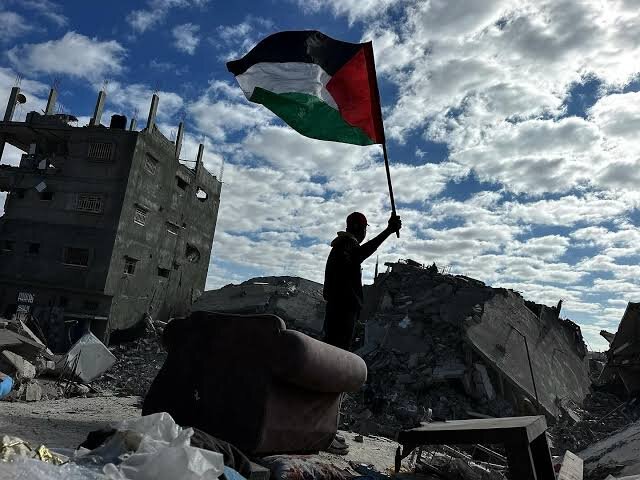
TEHRAN – Nothing has been more dangerous for Gaza over the past two years than the bombs and missiles that have fallen on it.
Except for the language used every time, U.S. President Donald Trump appears on television to promote his “peace plan” for the Strip.
This rhetoric comes as the Israeli regime’s aggression, killings, and violations of the truce agreement signed in Sharm el-Sheikh last October continue almost daily.
When the bombing of Gaza partially subsided, a different kind of war began. It became a war of maps, crossings, and reconstruction on one side, and a war of so-called “peace councils”, international forces, “the day after,” and new governance on the other.
Between these competing tracks, progress has moved at a snail’s pace. Promises to end suffering coexist with attempts to recycle the same political scene.
Meanwhile, the occupying Israeli regime works to reimpose a logic of military dominance, seeking to transfer the “Lebanon model” to Gaza in order to evade the political consequences of the current phase.
Much of what is being discussed today resembles a field of political landmines, efforts to entrench the results of failure and paralysis that no one dares to openly admit. The sacrifices and steadfastness of an entire population are being redirected into international projects with slim chances of success, while Palestinians still feel neither safe nor at peace.
This raises a fundamental question: is Gaza truly on the path to peace, or facing yet another illusion designed to save the international system from a painful admission of failure and bias?
Gaza, despite everything it has endured, has neither been defeated nor raised the white flag. It still holds the right to say no, at an exceptionally sensitive moment.
Talk of a “peace council” and an international force for Gaza has become a central topic in global discussions, far exceeding the Strip’s narrow geography. With every statement Trump makes about a special “peace council” for Gaza, the depth of the international system’s crisis becomes clearer.
After a long genocidal war in which the Zionist regime, as a military power, failed to achieve its goals or impose solutions by force, the regime, along with Washington, has been compelled to search for political exits to reset the situation.
Gaza, long treated as a purely humanitarian and security issue, has now imposed itself as a central dilemma confronting the United States and the international community. It raises a core question: who has the right to determine Gaza’s fate, by what means, and at whose expense?
The plan currently being discussed is based on a withdrawal by Israeli occupation forces from Gaza in exchange for Hamas’s complete exit from power, followed by the establishment of a new governing system run by an international force.
Under this proposal, Trump would sit at the top alongside a council of donor states, supported by an executive body overseeing a transitional phase, while a technocratic Palestinian government would operate inside Gaza.
The plan also includes the creation of an international stabilization force to maintain security and prevent attacks. The idea is to present this package as a single offer to both Hamas and the Israeli regime. The key question, however, remains how Palestinians themselves would respond to such an arrangement, and whether political factions would accept it.
What must be understood is that Gaza’s resistance against a two-year genocidal war with the Israeli occupation regime has disrupted major regional calculations.
When Trump repeatedly speaks of his “peace plan” one thing cannot be ignored: how can a besieged, devastated strip of land generate such intense global political attention?
The answer is clear. Gaza is no longer a marginal humanitarian issue to be silenced with temporary fixes or financial aid in exchange for calm. Through its resilience and sacrifice, it has become a political center of gravity reshaping the international stage and exposing the bias and moral bankruptcy of powers aligned with the Zionist regime.
The announcement of a “peace council” for Gaza does not stem from a humanitarian awakening. It reflects a deep crisis within the international system, especially within the Trump administration, after military force failed to subdue the Palestinians or break their resistance.
Gaza has revealed the limits of overwhelming power. The U.S.-backed Israeli regime’s military superiority failed to resolve the conflict, and the occupying regime’s moral narrative collapsed globally, leaving it increasingly isolated.
For decades, many viewed Gaza as marginal. The Zionists saw it as a refugee enclave hostile by nature. The Israeli regime repeatedly failed to develop a viable strategy for dealing with Gaza, which remains deeply rooted in Palestinian collective consciousness as a center of resistance. This is why it has always been difficult to contain. It was, and remains, a reminder that the Palestinians refuse disappearance or displacement.
Two years of genocide have exposed major regional power shifts. Gaza forced Israel into the longest war in the regime’s history, exhausting its army and shattering the image of invincibility.
Allies were pushed into moral justifications that convinced no one. Gaza became a global symbol of sacrifice and extraordinary resilience. Discussion of a “peace council” is, at its core, a U.S. attempt to manage the Israeli regime’s failure in Gaza and regain control of a genocidal war that had spiraled into a dead end. For decades, Washington sponsored so-called peace initiatives. Today, it faces a new reality: no settlement can be imposed by force, and no regional project can bypass Gaza.
Trump, driven by an economic mindset, sees Gaza as an opportunity to reorder the region and market himself as a peacemaker shaping a “new Middle East.” The occupying regime, meanwhile, sees a chance to rehabilitate itself after genocide and isolation, reinforcing the dominance of its far right.
For Netanyahu, the moment is existential, an attempt to manufacture a symbolic victory to avoid political collapse.
Across all these calculations, one constant remains: the Palestinian people and their resistance. Ignoring this reality reflects a deep misunderstanding of a people that refuses submission and cannot be reshaped to fit American political designs.
Talk has now shifted to a second phase of Trump’s plan, following what is described as the resistance fulfilling its commitments. Whether framed as reconstruction or political arrangements through a “peace council”, the genocidal war is likely to enter a new phase, no less intense, but more complex. The next battle will not be purely military; it will be a struggle over narrative, legitimacy, existence, and representation.
Reconstruction itself will become a tool of bargaining and pressure. The U.S. and the Zionist regime will push a formula of disarmament and calm in exchange for rebuilding. Past experience, however, shows that such coercion fails. Gaza has never fought to improve life under siege, but to break the siege itself, to end occupation, not coexist with it, and to claim freedom as a right, not a gift.
Gaza now faces a decisive test. The challenge is to assert a unified national equation that prevents it from becoming a regional bargaining chip or a laboratory for failed international projects. History shows that people who sacrifice for freedom are not defeated at negotiating tables, regardless of power imbalances. Gaza’s experience, like those of Iraq and Afghanistan, demonstrates that imposing solutions under the banner of peace ultimately fails.
One truth is clear: Gaza knows its path. No imposed peace, no council, can reduce its sacrifices to a footnote. Gaza will not become part of an American project, a bridge to a “new Middle East,” or a lifeline for failed politicians or dealmakers. The Palestinian people know that freedom is not granted, and peace is never born from submission.
Leave a Comment