The selective lens: Why some victims make headlines, and others are numbers
TEHRAN – In today’s world, media serve as the fundamental instrument for both shaping public opinion and actively constructing reality. Western media occupy a uniquely dominant position in this sphere, leveraging their vast organizational reach and advanced technological capabilities to lead global narrative-building.
These outlets possess the ability to effortlessly reverse the roles of victim and perpetrator, calibrating the coverage of global events strictly based on their alignment with, or divergence from, Western interests. The armed attack in Australia provides a stark and instructive case study of this mechanism.
Following the assault during a Jewish ceremony in Sydney, mainstream Western media immediately launched extensive coverage.
The headlines focused sharply on national shock, the threat to public security, and the necessity of social solidarity.
Reports were meticulously crafted with an intense emotional charge. Victims were humanized through the use of names, photographs, and personal life details, quickly establishing a news environment engineered to generate maximum public empathy.
This model of emotionally resonant coverage is standard and expected within common Western media frameworks.
The core problem, however, arises when this profound level of attention and sympathy is applied selectively.
The crucial question is not whether the coverage of the Sydney incident was appropriate, but why these same media outlets fail to apply this identical standard when reporting on other human catastrophes—most significantly, the unfolding tragedy in Gaza.
In the Sydney incident, victims were instantaneously elevated to central news subjects. Media detailed their personal lives, circulated intimate family images, and anchored the entire narrative around emotional resonance.
The saturation of coverage ensured the incident became a matter of grave concern for Western—and indeed global—public opinion.
The approach to covering developments in Gaza operates on a fundamentally different pattern. The martyrdom of over 70,000 Palestinians—especially women and children—is routinely relegated to mere aggregate statistics.
The names, faces, and individual narratives of these victims are conspicuously absent from mainstream media platforms, and the accompanying reportage adopts a characteristically neutral or clinical tone. Consequently, the essential human dimension is marginalized, stripping the events of their potent news impact.
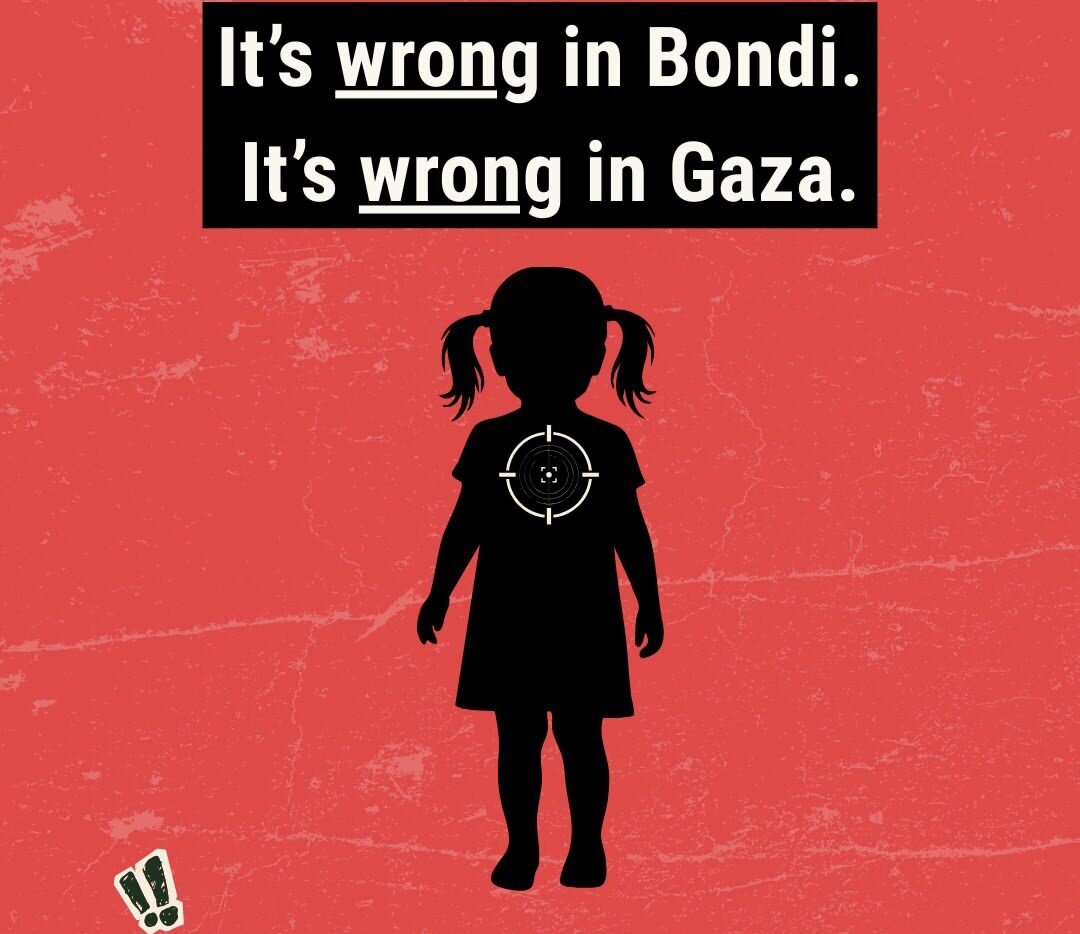
This profound disparity in narrative framing exposes a glaring double standard in the valuation of human life.
Within the operational logic of Western media, not all victims are regarded equally. Those situated within the geographical West or whose tragedy aligns with Western political interests are granted extensive and highly empathetic coverage.
In contrast, the victims of war crimes in regions such as Gaza are systematically sidelined and marginalized.
Equally revealing is the method used for attributing responsibility. In the Sydney coverage, the attacker is explicitly identified as a single, accountable individual, with direct responsibility for the violent act assigned to him.
Conversely, reports originating from Gaza employ specific, pervasive linguistic structures designed to obscure or entirely downplay the perpetrator.
The repeated use of passive phrasing, such as “were killed” or “lost their lives”—without explicitly naming the agent of the crime—dilutes and diminishes the perpetrator's role in the overarching narrative.
This differentiation has critical media consequences. When responsibility is deliberately obscured, the criminal act and the violence itself are presented as an ambiguous, almost inevitable reality.
Under these conditions, the audience is far less prompted to challenge or question the why and how of the events, allowing the official, dominant narrative to be accepted without serious critical examination.
Furthermore, the double standard in victim representation actively politicizes the very concept of empathy. Media sympathy, instead of operating as a universal human response, is transformed into a calculated, selective tool, which is activated or suppressed based solely on geopolitical location and political expediency.
This systemic pattern thoroughly invalidates the core claim of neutrality made by mainstream Western media. If violence and crime demand condemnation, that condemnation must adhere to an uncompromising, single standard.
It is intellectually and morally inconsistent to use the harshest possible language to denounce one form of violence while explaining another with clinical neutrality or justifying it via security rationalizations.
Ultimately, over the past several months, mainstream media have reduced Palestinian victims in the Gaza Strip to dehumanized statistics, creating a perception that the sacrifice of human life in this area is merely routine.
Yet, the intrinsic value of human life must be universally equal. It is indefensible to treat hundreds of thousands of martyrs in the Gaza Strip as abstract statistics while framing the killing of a handful of individuals as an event of profound shock.
The stark contrast in coverage between the Sydney incident and the Israeli crimes in Gaza unequivocally demonstrates the entrenched double standards governing Western media and their profound selective valuation of human lives.
Western media consistently foreground those victims they deem deserving of sympathy while actively marginalizing the plight of Palestinians.
Disturbingly, some of these outlets even go so far as to offer justification and whitewashing for the criminal faction responsible for this genocide.
This is the demonstrable reality dominating Western media—an apparatus relentlessly engaged in narrative-building and the calculated shaping of global public opinion.
Source: Sedaye Iran, the online newspaper of the Institute of the Islamic Revolution of Iran — Monday, December 15, 2025
Leave a Comment