
CCTV journalist highlights Khuzestan’s cultural heritage
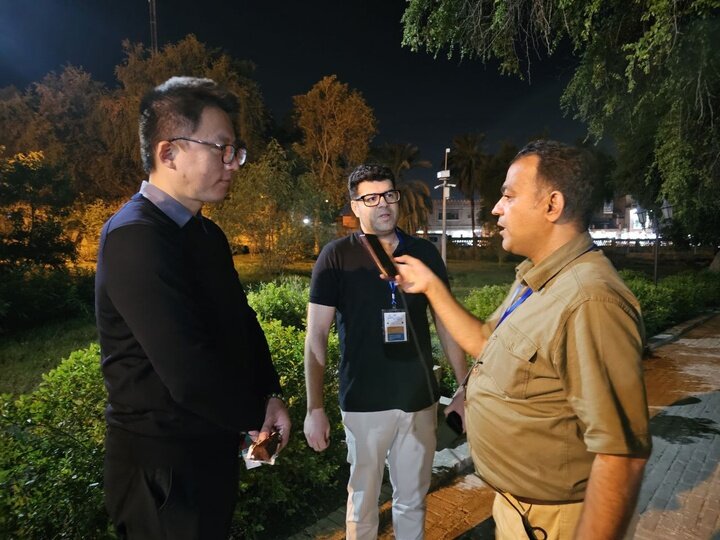
TEHRAN – A Chinese journalist has said Iran’s southwestern province of Khuzestan has strong appeal for international audiences, citing its rich cultural heritage and diversity.
Li Jiannan, a correspondent with China Central Television (CCTV), made the remarks on Thursday during his first visit to Khuzestan, describing the province as a destination that challenges common perceptions about Iran.
The remarks came ahead of the province’s hosting of the 4th International Multimedia Festival of Cultural Heritage, aimed at promoting Iran’s historical and cultural assets.
“I had traveled to many provinces and cities in Iran before, but Khuzestan was unknown to me,” Li said in an interview. “I had thought the province was mainly associated with oil, but after visiting Abadan, Khorramshahr and Ahvaz, I was completely surprised. The cultural heritage here is very different from other regions, and that difference is exciting.”
Li said he plans to visit several historical sites during his stay, including Dezful and Shushtar, and expressed interest in returning to explore more of the province. “In this short time, I want to see as many historical sites as possible. If I have the opportunity, I will definitely come back,” he said.
The Chinese journalist was visiting Khuzestan days before the fourth International Multimedia Cultural Heritage Festival. He described the province’s ethnic and cultural diversity as one of its most striking features.
“Each part of Khuzestan has its own identity, culture and traditions,” Li said. “From music and local dances to the hospitality of the people, every city feels different. In Abadan, Ahvaz and Khorramshahr, the urban atmosphere and the banks of the Karun River create a special feeling, while in Susa, history feels alive.”
Li said he had not been familiar with the festival before his visit but described it as an effective platform for introducing Iran’s cultural and historical assets to international audiences. “If I am invited again in the coming years, I will definitely attend and encourage my colleagues to join me,” he said. “This festival can play an important role in presenting Khuzestan’s cultural potential to the world.”

Speaking about his planned coverage for Chinese audiences, Li said he would focus on key heritage sites to present a clear and accessible picture of the province. “Given time limitations, I will highlight places such as Tchogha Zanbil and Susa, which are UNESCO World Heritage sites and represent the depth of Khuzestan’s history,” he said.
He concluded by inviting Chinese tourists to visit the province. “Khuzestan offers cultural diversity, traditional music, local cuisine, distinctive clothing and beautiful natural landscapes,” Li said. “It is a destination where visitors can experience the richness of southern Iran in a very direct way.”
Khuzestan is home to a wealth of cultural, historical, and natural attractions, making it one of Iran’s most diverse provinces for travelers. Its landscapes range from fertile plains along the Karun River to rugged Zagros Mountains, offering a wide variety of experiences.

Among the province’s most renowned ancient sites is Tchogha Zanbil, an Elamite complex dating back to 1250 BC and one of the few surviving ziggurats in the world. Another UNESCO World Heritage site, the Shushtar Historical Hydraulic System, demonstrates advanced water management and irrigation techniques dating to the 5th century BC.
Khuzestan also boasts Susa, one of the world’s oldest cities and the former capital of the Elamite Empire, with its ancient palace ruins and archaeological museum. The Chogha Mish site offers insight into early urban settlement in the region, while the Shushtar Bridge-Dam, part of the hydraulic system, remains an engineering marvel.
AM