
Fanning the flames: How US arms sales destabilize Taiwan and violate China’s sovereignty

TEHRAN – China’s decision to impose countermeasures on U.S. military-linked companies and senior executives is neither impulsive nor symbolic. It is a calibrated response to Washington’s latest and most provocative escalation on the Taiwan question: an unprecedented $11.1 billion arms package to China’s Taiwan region.
This move once again exposes a fundamental contradiction at the heart of U.S.-China policy—professing adherence to the one-China principle while steadily hollowing it out in practice. In doing so, the United States is playing with fire in one of the most sensitive fault lines in global geopolitics.
The Taiwan question is not a peripheral issue for China. It lies at the very center of China’s core interests, touching sovereignty, territorial integrity, and national dignity. It is the political bedrock upon which China–U.S. relations rest and the first red line that cannot be crossed. Yet Washington continues to test this boundary, step by step, weapon shipment by weapon shipment, as if erosion through repetition could somehow rewrite political reality.
One-China principle: A foundational pillar
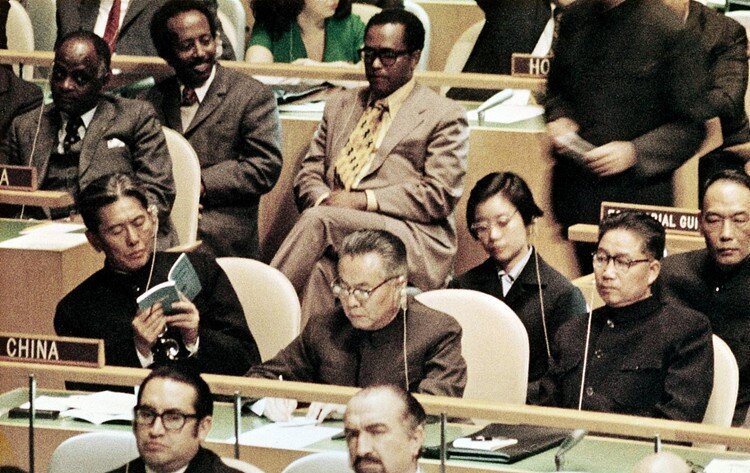
Chinese delegation attends the 26th Session of the United Nations General Assembly in New York, the U.S., Nov. 15, 1971
The one-China principle is not a concept devised by China for diplomatic convenience, but a widely recognized norm of international relations that underpins the post–World War II international order. It is reflected in United Nations General Assembly Resolution 2758 in 1971, which restored the lawful seat of the People’s Republic of China at the United Nations and recognized it as the sole legitimate representative of China. By decisively resolving the question of China’s representation and rejecting any arrangement involving “two Chinas” or “one China, one Taiwan,” the resolution provides an essential international legal and political foundation for the one-China principle. This principle constitutes the political basis of China’s relations with all countries, including the United States.
When China and the United States normalized relations, Washington explicitly acknowledged this reality. Such acknowledgment was neither ambiguous nor optional, but was formally codified in a series of joint political documents that continue to define the parameters of bilateral relations. Any attempt to hollow out or undermine the one-China principle, therefore, goes beyond a diplomatic disagreement; it strikes at the very foundation upon which China–U.S. relations were established and sustained.
From commitments to contradictions
The framework governing China–U.S. relations on Taiwan rests on three Joint Communiqués, each carrying clear obligations for the U.S. side.
The 1972 Shanghai Communiqué marked the starting point of normalization between the United States and China. In it, the United States stated that it “acknowledges that all Chinese on both sides of the Taiwan Strait maintain there is but one China and that Taiwan is a part of China.” This was a political acknowledgment of China’s position, reflecting a serious step toward recognition rather than a mere rhetorical courtesy.
The 1979 Joint Communiqué on the Establishment of Diplomatic Relations went further. The United States formally recognized the government of the People’s Republic of China as the sole legal government of China and committed itself to maintaining only unofficial relations with Taiwan. Basically, official diplomatic recognition of Beijing and military support for Taiwan are inherently incompatible.
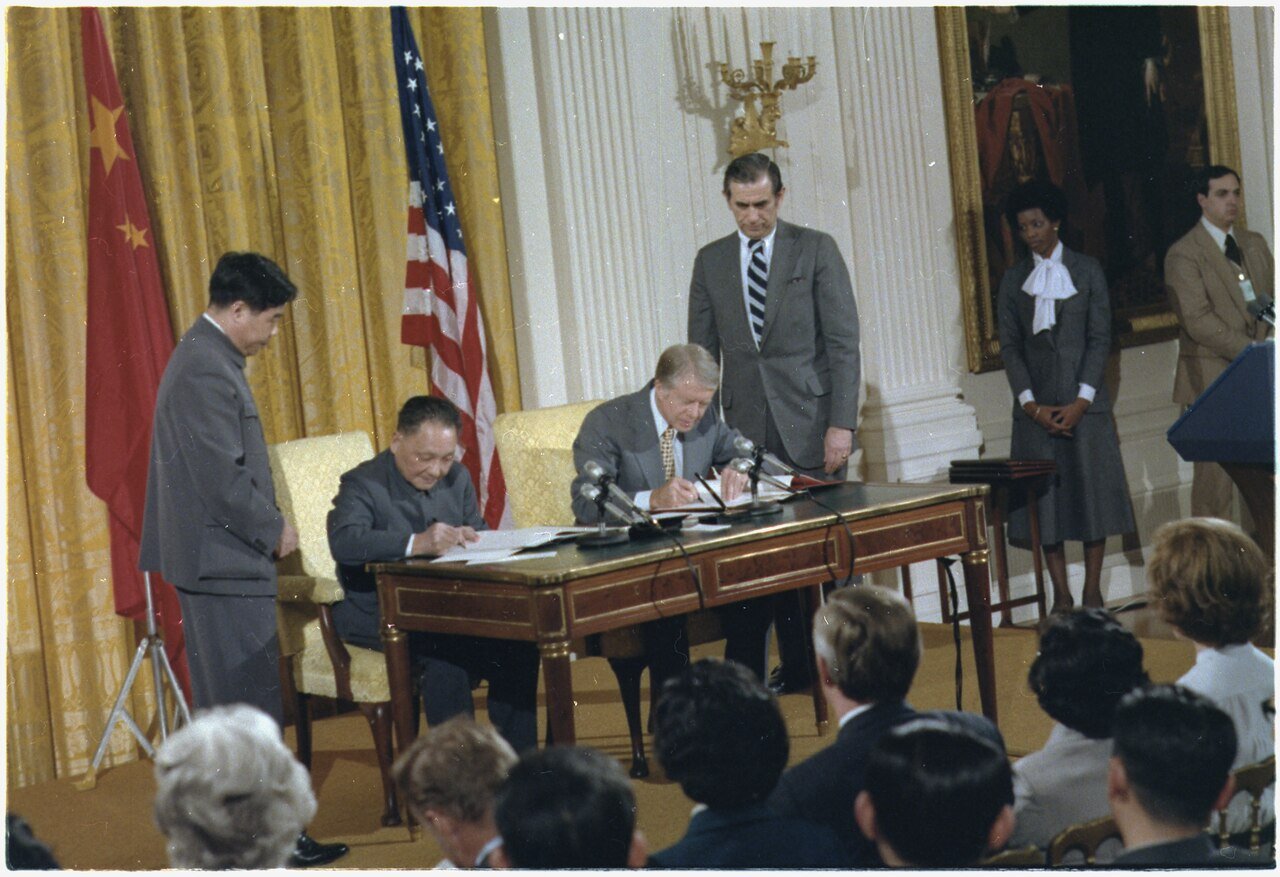
Chinese Vice Premier Deng Xiaoping and U.S. President Jimmy Carter at the signing ceremony during Deng's landmark visit to Washington in 1979, marking the release of the second U.S.-China communiqué
The 1982 August 17 Communiqué addressed the arms issue directly. In it, the United States pledged that it did not seek a long-term policy of arms sales to Taiwan and that such sales would neither exceed previous levels nor grow in quality or quantity. It also expressed an intention to gradually reduce and ultimately resolve the arms sales issue.
Today’s reality could not be further from those commitments. Far from reducing arms sales, Washington has expanded them in scale, sophistication, and frequency. What was once portrayed as “defensive” has steadily morphed into systems with clear offensive and strategic implications. The gap between U.S. words and actions has become so wide that credibility itself has fallen through the cracks.
Arming Taiwan breeds instability
The United States claims that its arms sales are meant to preserve “peace and stability” across the Taiwan Strait. This argument collapses under scrutiny.
Pouring advanced weaponry into a sensitive region does not extinguish flames; it fans them. It emboldens separatist elements on the island, distorts threat perceptions, and raises the risk of miscalculation.
Encouraged by U.S. backing, the Democratic Progressive Party authorities have increasingly indulged in the dangerous illusion of “seeking independence with external support.” Arms purchases are framed as security guarantees, yet in reality, they turn Taiwan into a forward outpost and a potential battlefield. The island is being transformed into a pawn on a geopolitical chessboard, its safety wagered for Washington’s strategic games.
Meanwhile, Taiwan residents are asked to foot the bill—billions diverted from social welfare, infrastructure, and public services into overpriced weapons that line the pockets of U.S. military contractors. It is a textbook case of selling fear at a premium, offering sugar-coated poison under the guise of security.
To understand Washington’s behavior, one must look beyond rhetoric and examine the driving logic behind its actions.
The United States treats Taiwan not as a people to protect, but as a pawn to contain China’s riseFirst is the lingering Cold War mindset. Seeing China as a strategic rival, the United States treats Taiwan not as a people to protect, but as a pawn to contain China’s rise—a convenient lever along the so-called first island chain. Its massive arms sales are not about Taiwan’s security; they are designed to slow China’s development and obstruct national reunification.
Second is the grip of the military-industrial complex. U.S. arms sales to Taiwan are a lucrative treadmill of tension: political figures approve deals while in office, then walk through the revolving door into defense corporations, ensuring that profit continually outbids prudence. Taiwan’s billions are funneled into weapons that serve Washington’s interests, not the island’s, a bitter gift disguised as protection.
Third is Washington’s habit of managing instability rather than fostering peace. A perpetually tense Taiwan Strait allows the United States to justify its military presence, assert influence over regional allies, and maintain its self-styled role as the “stabilizer.” Such brinkmanship may serve American ambition, but it does so at the expense of regional stability and the well-being of the Taiwanese people.
China’s countermeasures: Lawful and proportionate
China’s recent countermeasures are neither excessive nor arbitrary. They are fully grounded in domestic law, particularly the Anti-Foreign Sanctions Law, and align with international legal principles. Sovereign nations have the right to protect their territorial integrity and core interests when threatened.
The measures are precisely targeted at U.S. entities and individuals directly involved in arms sales to Taiwan, sparing ordinary citizens and legitimate commercial activity. This restraint underscores China’s responsible and lawful approach, sending a clear message: actions undermining China’s sovereignty will have proportionate consequences.
More broadly, these countermeasures reveal the true cost of U.S. provocations and expose the pretense of “defensive arms sales.” They curb the overconfidence of separatist forces in Taiwan and reaffirm that external interference cannot alter China’s historical trajectory or determination.
China remains committed to peaceful reunification, dialogue, and development, but peace is not passive, and restraint does not imply surrender. On matters of sovereignty, China’s position is firm and uncompromising. The reunification of China is not a question of if, but when—anchored in historical legitimacy, law, and the collective will of the Chinese people.
Attempts to use Taiwan as a lever to contain China are ultimately doomed to fail, like trying to dam a rising tide with paper walls. The United States should honor its previous commitments, respect the one-China principle, and halt its destabilizing arms sales. Failure to do so will further erode trust and narrow the path to regional stability.
China’s resolve is clear, its patience measured, and its determination unwavering. The red line has been drawn. Crossing it will not halt history—it will only hasten the consequences.