
Netanyahu’s agenda
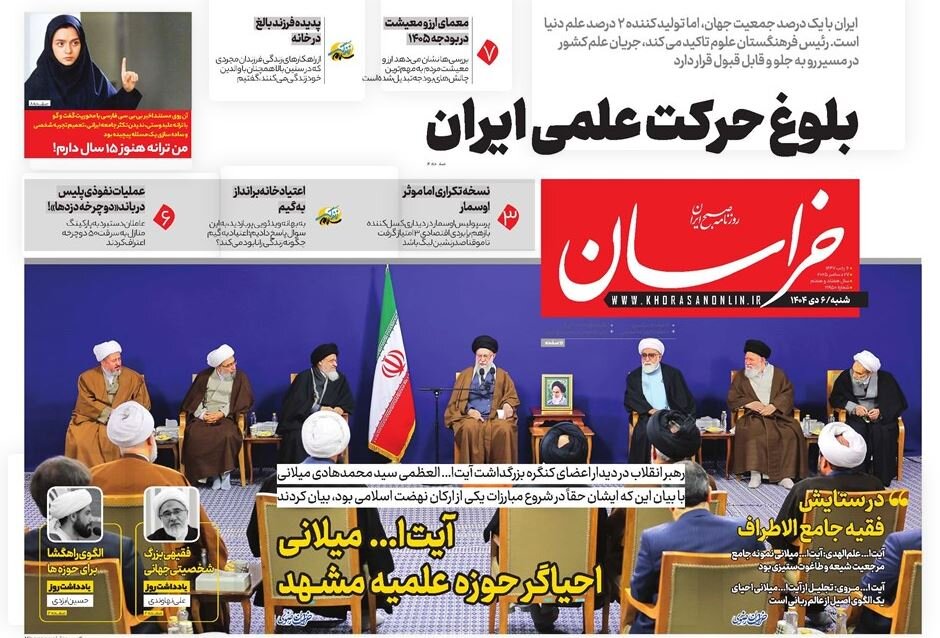
TEHRAN - Khorasan analyzed the objectives of the Israeli Prime Minister’s looming trip to the United States for talks with Donald Trump.
The report notes that this visit follows a telephone conversation between the two sides about three weeks ago. The purpose of that call, initiated by Trump, was to encourage Netanyahu to move into the second phase of the Gaza agreement. However, it appears that Bibi (the nickname for Netnayahu) also raised issues related to Iran and other matters. The agenda of the talks includes Iran, Gaza, Lebanon, Syria, and Iraq; files that are interconnected in various ways. Yet the analysis suggests that the most important dossiers are Iran and Gaza. It is no secret that Netanyahu seeks to persuade Trump to launch another attack on Iran. Trump may give Israel the green light, or he himself may participate directly or indirectly. Regarding the linkage between the Iran and Gaza files, the paper argues that it is not unlikely that Netanyahu will show some degree of cooperation on Gaza to secure Trump’s support on Iran and even Hezbollah. This has happened before: following the Gaza ceasefire agreement, the U.S. president stated several times that without an attack on Iran, the Gaza deal would not have been achieved. The question now is how far Netanyahu can go in his upcoming trip to win Trump’s approval for another round of confrontation with Iran.
Arman-e-Melli: Economic diplomacy is a strategy against sanctions
Arman-e-Melli, in a commentary, examined the closure of negotiation channels and redefinition of Iran’s foreign policy tools. The article states that with traditional political avenues for reducing external pressure effectively blocked, and with little prospect of returning to the negotiating table, the Islamic Republic has been compelled to redefine its foreign policy. The closure of talks with the United States and other Western countries does not mean a complete halt to diplomatic moves; rather, it signals a transformation of classical political diplomacy and a pivot toward regional policies. In this context, the government seeks to use economic, commercial, and regional capacities to reduce the intensity and impact of sanctions and to manage their costs for the national economy. According to recent remarks by Foreign Minister Seyed Abbas Araghchi, the Western aim is not the direct lifting of sanctions but a reduction of their practical effects on people’s lives and the country’s economy. The sitting government’s speedy move toward economic diplomacy reflects a kind of realism in foreign policy: it acknowledges that favorable international conditions are not attainable in the short term, but with initiative, the costs can be controlled.
Hamshahri: Trump neither seeks full‑scale war nor complete passivity
Hamshahri evaluated U.S. foreign policy behavior. It argues that in recent years, Washington’s approach toward countries such as Venezuela, Cuba, Iran, and the Middle East has converged on a clear pattern: neither full‑scale war nor complete passivity, but rather sustained, selective, and targeted pressure. In the Middle East, Trump’s logic of selective deterrence has been repeatedly observed. Iran, as America’s strategic rival, is neither subjected to direct military assaults nor entirely excluded from the international arena. Instead, it faces sanctions, banking and insurance restrictions, and limited military actions; measures designed to control and reduce its threat capacity rather than eliminate it outright or trigger total war. On Iraq and Iranian influence there, Trump has pursued a dual strategy: bolstering domestic political currents opposed to Tehran’s direct sway, while simultaneously pressuring Iran‑linked financial and security networks. This combined behavior amounts to a two‑track strategy, described in terms such as “economic and judicial deterrence” or “targeted pressure without war.”
Ham Mihan: We must negotiate secretly with US
Ham Mihan, in an interview with geopolitics professor Abdolreza Faraji‑Rad, commented on a recent UN Security Council session on Iran with a focus on Resolution 2231. Despite opposition from China and Russia, Western powers sought to hold these meetings every six months unless two conditions were met: first, that Iran and the U.S. engage in negotiations during that period with relative satisfaction or ongoing talks, making such sessions unnecessary; second, that the IAEA gain access to the four bombed Iranian nuclear sites, removing the need for further deliberation. Faraji‑Rad argued that the time has come to initiate a form of negotiation shielded from regional spoilers. If talks are public, Israel, its lobbyists, and Iran’s regional geopolitical rivals will mobilize against them. No one in the region wants war, but equally, no one wants Iran and the U.S. to reach an agreement, since they fear a stronger Iran. Both sides have conditions, and for that reason, open negotiations no longer succeed, because the matter has become a question of prestige for both countries.