
Grossi heroized by Western media: Bias and IAEA limits ignored
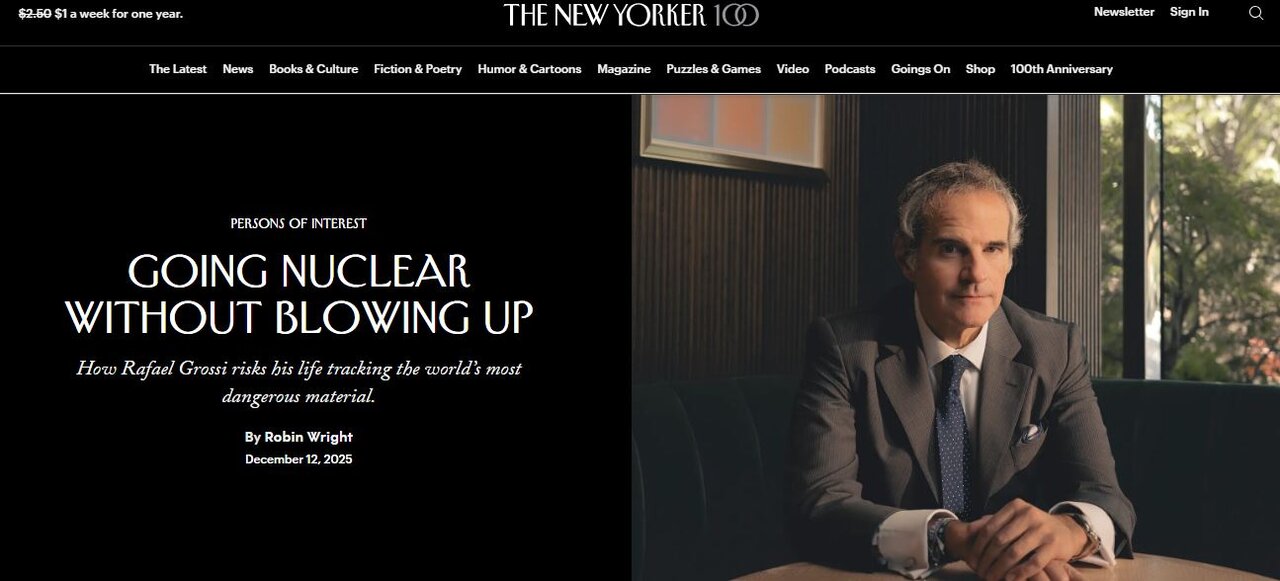
Recent Western media portrayals have elevated Rafael Grossi, director-general of the International Atomic Energy Agency (IAEA), to the status of a heroic figure. He is depicted as a courageous and resolute leader, capable of cutting through the geopolitical chaos and institutional paralysis that often hinder global nuclear oversight.
These narratives also overlook instances where Grossi acted merely in accordance with Western interests, creating situations that could have led to humanitarian and environmental catastrophe, such as his handling of Iran’s nuclear file.
Robin Wright’s recent piece in The New Yorker is a prime example of this glorification. It frames Grossi as a singularly courageous, tireless, and uniquely capable individual, while diverting attention from the IAEA’s deep structural limitations and the broader political forces shaping nuclear governance.
The issue with such articles isn’t their recognition of Grossi’s leadership, but their failure to engage with the systemic and geopolitical challenges that no individual, however capable, can overcome. Such narrative choices are not merely stylistic; they obscure the fundamental constraints under which the IAEA operates, and inflate the significance of individual agency at the expense of structural power.
At Zaporizhzhia, for instance, Grossi’s intervention was brave, but it did not alter the basic political facts on the ground: Russia retained military control of the facility; Ukraine remained unable to exercise sovereign authority over inspections; and the IAEA acquired no enforceable guarantees that could prevent shelling, sabotage, or deliberate escalation. The presence of inspectors mitigated some risks, but it did not neutralize the strategic leverage that control of a nuclear facility confers during wartime.
In other regions, like West Asia, the trait attributed to Grossi's leadership is not "bravery" or "courage," but a lack of both authority and neutrality. The article fails to address crucial questions: If Grossi's model of leadership is truly transformative, why does the IAEA still lack enforcement mechanisms? Why does it lack guaranteed access to nuclear facilities in various regions, such as Israel? Why did the IAEA take no action regarding US-Israeli attacks on Iran's nuclear sites, which were among the most vigorously inspected in the world? Furthermore, why does Grossi seek renewed access to Iran's facilities without any guarantee they will not be attacked again?
The IAEA is not hampered by a lack of initiative or imagination; rather, it is constrained by its own architecture. Its authority derives almost entirely from the consent of only certain states—especially those most capable of violating nuclear norms. The article invites readers to believe that leadership can substitute for power, a notion that is fundamentally flawed.
The IAEA’s lack of power in situations like Iran’s is made all the more concerning by the fact that, in many cases, Grossi has aided the West in pressuring Iran. Grossi's reports in recent years have condemned Iran’s acceleration of nuclear activities, while failing to acknowledge that this surge was a direct consequence of the U.S. withdrawal from the Joint Comprehensive Plan of Action (JCPOA). The Trump administration’s decision to pull out and reimpose sanctions profoundly altered Tehran’s geopolitical calculations. By focusing solely on Iran’s actions without highlighting the U.S. role in destabilizing the deal, Grossi misrepresented the situation as an unprovoked Iranian move, ignoring how U.S. policy contributed to the very proliferation it claims to prevent.
Articles like the one in question, present Grossi's argument that horizontal nuclear proliferation (the spread of nuclear weapons to additional states or non-state actors) is more destabilizing than vertical proliferation (the expansion of existing nuclear arsenals). While Grossi's assertion may be technically valid in certain contexts, the article fails to critically examine or contextualize its broader implications. Specifically, this argument deflects attention from the actions of nuclear-armed states like the U.S. and Israel, which have significantly contributed to instability through their own policies and behaviors.
To make a long story short, in the realm of nuclear governance, Grossi is neither a hero nor a history-making figure. The IAEA does not possess that authority, and in many instances, Grossi has lacked the necessary neutrality. No amount of breathless hero-worship in the media will change that.