
The colonial reconfiguration: Israel and the extinction of sovereignty in West Asia
MADRID – In the conventional diplomatic lexicon, “normalization” is typically framed as an intrinsic good: the peaceful acceptance of a state within recognized borders, integrated into the regional economic and security architecture. It is a term that evokes closure and resolution.
But applied to the Israeli project in the contemporary West Asia, it becomes profoundly misleading. Israel does not seek to normalize itself as another state among states, subject to the classical principles of territorial sovereignty and non-intervention. Rather, it aspires to normalize an order of a fundamentally different nature: that of an expansionist power that continuously redefines the contours and content of its neighbors’ sovereignty.
In this context, Lebanon’s recent political pivot toward Israel, including moves to criminalize Resistance, does not represent progress toward a peace between equals. It marks instead a gradual incorporation into a project that dilutes Lebanese sovereignty in exchange for externally managed stability. The current dynamic—shaped by a recent invasion and a precarious truce—reveals the workings of a system whose ultimate logic is the comprehensive reconfiguration of the regional environment.
This process is not a temporary aberration of Israeli policy but the contemporary expression of a foundational logic adapted to 21st-century geopolitical realities, where the consolidation of power does not always require formal annexation but rather the ability to subordinate another actor’s political will. Against this backdrop, the Iranian position—grounded in the defense of regional sovereignty and in deterrence against external pressure—appears, for many local actors, not as an anomaly but as one of the few effective constraints on this profoundly asymmetrical form of normalization.
The essential distinction: occupation vs. settler colonialism
The distinction between occupation and colonialism is critical in this debate. Occupation is, in theory, a temporary state of military control over foreign territory, governed by international conventions that presume its provisional character. Colonialism, by contrast—especially settler colonialism—is a structural and enduring system. It does not merely exercise control; it seeks to transform permanently the human, political, and physical landscape. It operates through a project of replacement in which the settler population arrives not merely to exploit but to remain, building a new society on the foundations—or more precisely, on the ruins—of the old. Native sovereignty is not suspended; it is denied at its root.
The Israeli project fits this framework not only because of the settlements in the West Bank but because of its strategic objective of deep geopolitical reconfiguration. This logic manifests in the constant effort to demilitarize neighboring states, to alter maritime and land borders through faits accomplis and asymmetric pressure, and to fragment the political and territorial contiguity of the populations under its dominance. The aim is to impose a regional hegemony in which the political and economic autonomy of states hinges on their acceptance of security parameters unilaterally defined. Sovereignty thus ceases to be an inviolable right derived from the existence of a political community and becomes a functional privilege granted by the dominant power, whose scope and vigor depend entirely on compliance.
This logic cannot be attributed to any single government or leader. It is the underlying structure of a national project that views the permanent vulnerability of its neighbors as the necessary condition for its own security and expansion.
Lebanon: The theatre of colonial reconfiguration
Lebanon has become the clearest and most dramatic stage for this dynamic. The country, already fractured by sectarian divisions and governed by a deeply clientelist political class, was suffering one of the worst economic crises in modern history even before the most recent conflict. Its army—symbol of a fragile sovereignty—was underequipped and demoralized, with soldiers earning roughly $60 a month. This structural weakness creates the ideal terrain for external interference and for the imposition of solutions that, under the guise of stability, consummate the erosion of national agency.
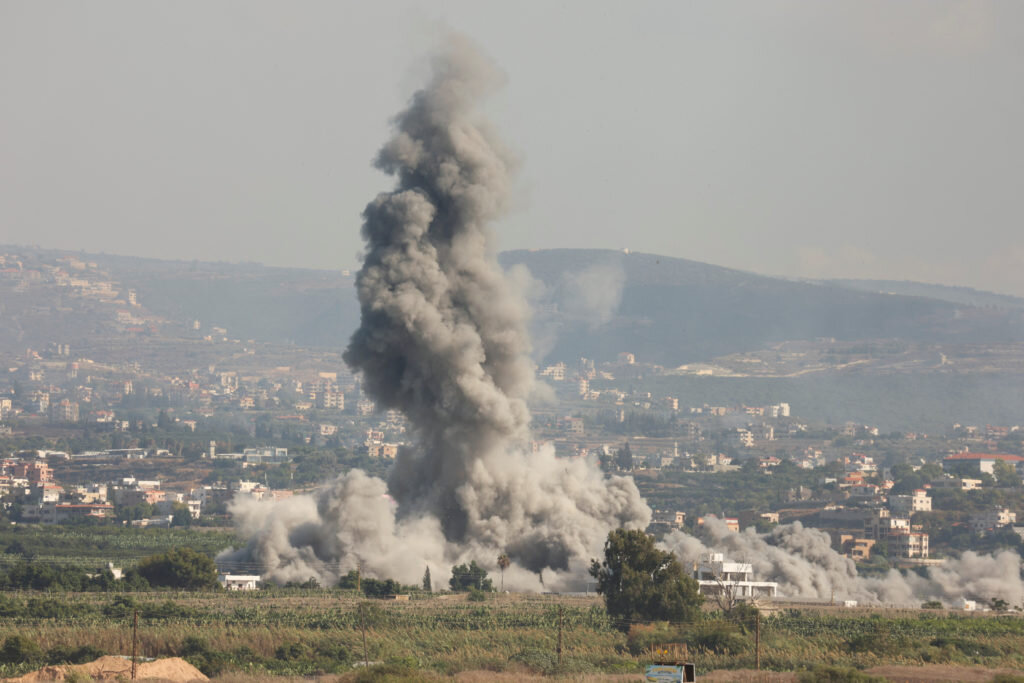
The operational turning point came between October and November 2024, when Israel launched a large-scale ground invasion of southern Lebanon. The operation was presented as a response to Hezbollah rocket fire and as an attempt to allow displaced Israelis in the north to return home. Yet the resulting devastation reveals the true nature of the intervention. According to Lebanese government figures, more than 2,720 people—overwhelmingly civilians—were killed. At least 1.4 million Lebanese civilians were displaced from their homes, a massive exodus that emptied entire towns.
The ceasefire agreement of November 27, 2024—violated countless times by Israel—required full withdrawal of Israeli forces. Yet Israel refused to meet the initial deadline and maintained five “strategic” military positions inside Lebanese territory, a sustained and blatant violation of sovereignty. This is not the behavior of a state withdrawing after a limited incursion, but that of a power consolidating territorial gains and establishing new facts on the ground.
The invasion was followed not by an orderly retreat but by a campaign of massive and systematic destruction described by field reports as deliberate and gratuitous. Investigations by Amnesty International indicate that between October 2024 and January 2025, the Israeli army methodically damaged or destroyed more than 10,000 civilian structures in southern Lebanon. This devastation was not carried out with long-range artillery but through manually placed explosives and bulldozers—methods that require total and prolonged control of the area. In municipalities such as Yarine, Dhayra, and Boustane, more than 70 percent of buildings were razed to their foundations. The destruction included homes, mosques, cemeteries, and the agricultural lands sustaining the local economy, with documented instances of Israeli soldiers filming themselves celebrating the explosions. A resident of Kfar Kila, who lost 900 century-old family trees, captured the emotional toll: “These homes and orchards were the last remnants of my grandparents… Losing a house is like losing a family member again.”
This pattern exceeds the logic of military tactics or “collateral damage.” It approaches the execution of colonial erasure—a classical mechanism through which a colonizing power destroys the material, economic, and cultural heritage of a subject population to sever the bonds between people and land, between the present and the memory that sustains it.
This process of subjugation has its counterpart in Lebanon’s internal political sphere. A decisive symbolic moment occurred when Lebanese security forces zealously repressed a protest in the south in which Israeli and American flags were burned. This was not a routine law-and-order operation. It was the visible enactment of a state internalizing and executing the core mandate of the colonial order: the criminalization of resistance as a legitimate political logic. By cracking down on symbolic acts of defiance, the Lebanese state apparatus was performing from within the heaviest labor of colonial normalization. It conveyed, unmistakably, that the emotional and political sovereignty of its own population must conform to boundaries defined by the sensitivities and interests of an external hegemon. It is the counterpart to the technical negotiations over maritime borders. While those talks normalize the material and legal reconfiguration of the nation’s contours, internal repression normalizes the reconfiguration of the permissible political space—of what may be thought and expressed without consequence. In its desperate search for immediate survival, the Lebanese state thus becomes the local administrator of an order that fundamentally denies it the possibility of full and authentic sovereignty.
The deeper objective: Extinguishing Resistance as a political and social logic
At the heart of this colonial project lies an objective more ambitious than the tactical neutralization of Hezbollah or Hamas. What is targeted is Resistance itself as a viable political and social logic. The goal is to eliminate the organic capacity of any collective force—state, sub-state, or societal—to imagine, assert, and defend autonomous or counter-hegemonic sovereignty. The aim is not merely to disarm a specific militia, but to eradicate the structural, ideological, social, economic, and psychological conditions under which any future resistance could emerge and thrive. It is an attempt to create a regional environment sterile to political autonomy—an engineered greenhouse where governance options and public debates are predetermined and circumscribed by their ultimate compatibility with Israeli hegemony. In this framework, peace ceases to be the product of an accord between free wills; it becomes synonymous with administered submission and an externally managed absence of conflict.
This effort is evident in the current international pressure on the Lebanese government. With explicit American backing, a plan for the disarmament of militias has been pushed forward, beginning with the area south of the Litani River. Although this process appears to have advanced on paper—Lebanese authorities claim to have dismantled over 90 percent of Hezbollah-linked military infrastructure in that zone—it unfolds under extreme and overt coercion. Israeli War Minister Israel Katz asserted in November 2025 that the Israeli army would intervene “with force” if Hezbollah was not disarmed by year’s end. This is not a diplomatic recommendation; it is an ultimatum placing Lebanon before an impossible choice: enforce a security policy dictated from abroad, becoming the local executor of an alien agenda, or face renewed devastation and occupation. Lebanese sovereignty is thus subordinated to hegemonic ends.
The international community, led by the United States and France on the ceasefire monitoring committee, exerts pressure with selective efficacy, often prioritizing the disarmament of Resistance over correcting Israeli violations. Regional powers such as Saudi Arabia and Qatar condition desperately needed reconstruction aid on verifiable progress in the disarmament process. The result is a state trapped in a perfect vise, its sovereignty negotiated on foreign tables and curtailed under existential threats. President Joseph Aoun embodies this untenable position—forced to denounce Israeli violations while acknowledging the state’s material inability to stop them, and compelled to maintain an increasingly fragile internal balance.
Iran: The inevitable dialectical counterpoint and the spiral of confrontation
Within this context, the Islamic Republic of Iran emerges not as a conventional disruptive actor but as the logical structural counterpoint to this hegemonic project. If Israel’s strategic aim is to render Resistance a criminalized anomaly, Iran has deliberately positioned itself as the primary supporter of Resistance as an alternative principle of regional order. Its support for Hezbollah—and its broader network of allies across Iraq, Syria, and Yemen—is not merely a geopolitical power play. It is the organic articulation of a counter-order that rejects the rules imposed by the colonial framework and grounds itself in the legitimacy of asymmetric confrontation as a defensive mechanism. Tehran does not simply act as a regional rival to Tel Aviv; it presents itself as its philosophical and operational antithesis. While the Israeli project seeks to hollow out and subordinate neighboring sovereignties, Iran positions itself—with all its contradictions—as an external guarantor of resistant, defensive sovereignty, sustained by non-state actors and nourished by an anti-hegemonic narrative.
This dynamic renders the conflict irreducible to a dispute over territory or spheres of influence. It is a struggle over the nature of power, sovereignty, and political legitimacy in the region. Israel’s attempt to extinguish resistance as a political principle dialectically produces Iran as its inevitable opposing pole. This logic grants Tehran an indispensable structural role that, in a less coercive regional environment, it might not possess. Iran is, in this precise sense, a dialectical creation of Israel’s colonial strategy: the more vigorously a model of limited, conditional, and administered sovereignty is imposed, the more forcefully the Iranian principle of resistant sovereignty emerges. It is a self-reinforcing spiral—each act of colonial normalization and repression on one front (such as the attempt to pacify Lebanon through destruction and disarmament) generates a stronger, more legitimized consolidation of resistance on the other, deepening regional division.
The crossroads
For Lebanon, caught in the eye of this geopolitical storm, the crossroads is existential. The choice is not between policies but between radically different models of the future for the very idea of Lebanon as a political community. The path of technical normalization and imposed security cooperation leads to a future in which statehood becomes an empty shell—a de facto protectorate with its economy, foreign policy, and internal stability subordinated to an external hegemon. Sovereignty would be reduced to an administrative ritual serving to efficiently manage colonial domination.
The alternative—rooted in asymmetric deterrence and refusal to normalize occupation—is painful and costly. It entails constant risk, periodic destruction, and crushing economic strain. But it preserves, however precariously, the possibility of autonomous political agency. It keeps alive the capacity for collective decision-making, even under extreme duress. Thus, the choice Lebanon faces is not between war and peace in the abstract, but between two radically different forms of peace. One is the peace of subordination, promising stability at the price of sovereignty. The other is a peace rooted in unstable deterrence, preserving the possibility of resistance and, with it, a deeper, more demanding, and more painful conception of independence.
The lesson for the region is unequivocal. The normalization offered by centers of power is not the mature conclusion of conflict but the institutionalization of a hierarchical and neo-colonial relationship. It transforms sovereignty into a conditional privilege, revocable based on political behavior. And by seeking to eradicate the logic of resistance entirely, it ensures that resistance finds a state sponsor, grows more radicalized, and becomes the organizing principle of a region fragmented and antagonistic at its core. Lebanon, with its tentative steps toward technical negotiations and its repression of symbolic dissent, is not securing a stable foothold in a pacified region. It is being induced, piece by piece, to normalize its own subordination.
The region’s future is thus suspended between administered submission and a resistance that, however catastrophic and painful, keeps alive the possibility of genuine sovereignty. It is a poisoned dialectic that the colonial project itself—seeking impossible security through absolute dominance—continues to fuel to the breaking point.