
Cultural diplomacy and the ambassador who crafts narratives
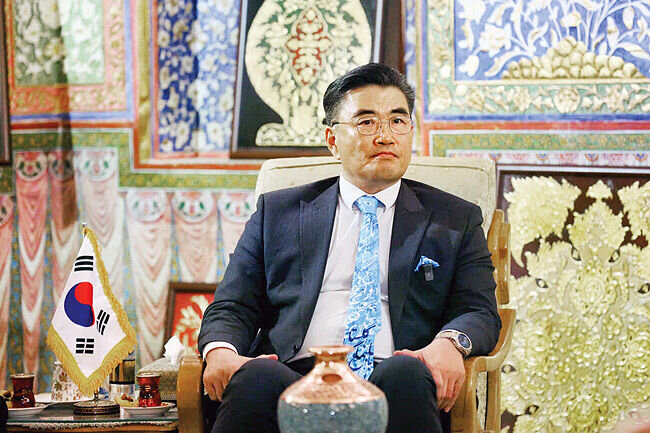
TEHRAN- The South Korean ambassador to Iran appeared in Isfahan wearing a tie adorned with Persian verses in Nasta'liq script. His cultural diplomacy as an ambassador can be evaluated as highly expressive, instructive, and impactful. Kim Junpyo has consciously, through his cultural actions, fostered a sense of intimacy and cultural closeness between the two countries and demonstrated how important cultural diplomacy can be—even through cultural signs and symbols. The question now is: to what extent does Iran utilize this capacity and soft power of its own?
Kim Junpyo, the South Korean ambassador to Iran, who previously performed Persian songs such as “Jan-e Maryam” and “Porsoon Porsoon,” this time during a visit to Isfahan Science and Research Park and several other centers, appeared wearing a tie featuring Persian verses in Nasta'liq script. This decision, following his past cultural actions, shows that the Korean ambassador is consciously—and likely with a specific plan—taking steps to connect with the hearts and social fabric of the Iranian people.
This small gesture is an example of what experts call “cultural diplomacy.” Beyond speeches and negotiations, cultural diplomacy can convey intimate and informal messages, opening a window to the heart of a society. A tie with Persian verses is not merely an accessory but a symbol of respect for the host culture and an effort to build trust, establishing a kind of human connection with the target society. This choice by the Korean ambassador clearly shows how even small details, such as the type of tie worn, can be highly effective in international relations.
From this perspective, the Korean ambassador can be seen as a kind of content creator—not only an official representative of his government but someone who crafts narratives through the language of culture. Performing Persian songs and wearing a Nasta'liq-patterned tie are all part of an informal narrative that people can relate to. From this viewpoint, it can be said that public diplomacy is impactful when the audience forms a human connection with the ambassador and his actions, rather than merely observing the role of an official figure. Therefore, the most successful ambassadors today are those who go beyond protocol, craft narratives, and convey a story about their country to the world.
Of course, this action by the ambassador can also be examined from another angle: national branding. When a foreign ambassador utilizes the cultural elements and symbols of a country, it shows the world that this culture and art have international influence and credibility. Nasta'liq script, Persian music, and classical literature are all part of Iran’s soft power, derived from a rich civilization—assets that, if used purposefully, can help create a cultural image of Iran on the international stage. Thus, by using a Nasta'liq-patterned tie, the Korean ambassador effectively highlighted this soft power and, without the need for official propaganda, attested to Iran’s cultural strength.
But why do such seemingly simple actions have such a profound impact? The answer lies in human connection. Communication psychology suggests that people are more influenced by emotional commonalities and shared symbols than by formal speeches and dry arguments. A tie, a song, or even a sincere smile can break down walls of mistrust, creating space for dialogue and interaction.
Of course, it’s worth noting that this approach is not unique to South Korea. There are many global examples showing that leaders and diplomats strengthen their connection with people by using cultural symbols and adopting the traditional attire of host countries.
In the case of South Korea, examples ranging from kimchi to the music genre known as K-pop illustrate that when soft power is employed consciously and creatively, it can be highly influential. By establishing a national brand internationally, it can carve out a place in the minds of people worldwide and serve as a strong foundation for boosting tourism and the cultural economy. In other words, this soft power can provide a basis for long-term interactions and create conditions that bring closer to reality the long-standing slogan of an “oil-free economy.”
It is precisely at this point that Iran, with its immense and rich culture, has a great opportunity. A rich cultural heritage, traditional music, and Nasta’liq script are tools that can indirectly enhance Iran’s image in the world. However, it is quite evident that utilizing such assets requires a conscious and strategic vision.
Learning from successful global examples and paying attention to the country’s internal capacities presents a significant opportunity for Iran to claim a larger share of the cultural diplomacy stage. In a world where tensions and political rivalries centered on the West Asia are high, cultural diplomacy can serve as a form of peace diplomacy.
* This article is a translation of a piece written by Mohammad Rezaei-Fard and published in the Donya-e Eghtesad newspaper on December 2nd.