What Iran’s foreign ministry spokesman said at his weekly briefing
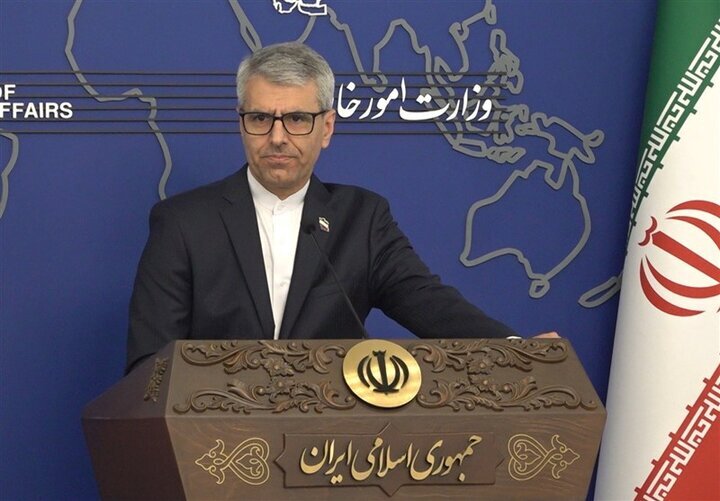
TEHRAN – Iran’s Foreign Ministry Spokesperson has addressed a wide range of regional and international issues, from U.S. visa restrictions for World Cup participants to tensions in the West Asia, underscoring Tehran’s positions on sovereignty, security, and diplomacy.
‘Iran’s expectation is entirely legal: FIFA must fulfill its duties’
Addressing the reporters during his press briefing on Sunday, Esmaeil Baqaei urged FIFA to uphold its responsibilities as the organizer of the World Cup after reports that the United States may deny visas to Iranian spectators and delegation members.
Baqaei described Iran’s expectation as “entirely legal and reasonable” and stressed that FIFA must guarantee access for all participating teams, coaches, and officials.
‘Israel’s actions show it does not belong in the region’
Baqaei reported a dire humanitarian situation in Gaza, where nearly 400 Palestinians were killed following a recent ceasefire. He criticized threats against international human rights monitors, including the UN Special Rapporteur on Palestinian Human Rights, and urged swift action to halt further violence in Gaza and other regional hotspots.
He also addressed Israel, calling it an “expansionist regime” and saying its military actions in Gaza over the past two years have caused destruction equivalent to 12 Hiroshima bombs, underscoring that Israel does not belong in the region.
It has been more than 50 days since a ceasefire between Israel and Hamas took effect, intended to end the Gaza war. However, the Israeli bombardment has continued unabated, and the humanitarian crisis has only deepened.
Since the war began in October 2023, more than 70,100 Palestinian people have been killed and over 170,000 wounded. Since the October 10 truce, 360 Palestinians have also been killed.
‘U.S. National Security Strategy prioritizes Israel over America’
On the release of the new U.S. National Security Strategy, Baqaei said the document “candidly reflects long-standing U.S. priorities in West Asia: access to energy resources and ensuring Israel’s security.”
He described it as more of an Israeli national security document than an American one, noting it takes pride in past attacks on Iran’s nuclear facilities, which he said implies U.S. acceptance of international responsibility for those actions.
Two days ago, the administration of US President Donald Trump unveiled the 2025 NSS.
The 33-page document said West Asia is no longer Washington’s top strategic priority, describing the region’s energy reserves as the “historic reason” for America’s focus there.
‘No doubt over Iran’s sovereignty of trio Persian Gulf islands’
Reaffirming Iran’s sovereignty over the three strategic Persian Gulf islands, Baqaei dismissed claims by the UAE and Persian Gulf Cooperation Council countries as baseless.
Historically, the Persian Gulf islands of Bu Musa and the Greater and Lesser Tunbs have belonged to Iran, a fact supported by numerous historical, legal, and geographical documents both within Iran and globally.
Nonetheless, the United Arab Emirates has repeatedly asserted claims over the islands.
The islands came under British control in 1921, but on November 30, 1971—one day after British forces withdrew and two days before the UAE formally became a federation—Iran’s sovereignty over them was reinstated.
Iran has also designated November 30 as the Persian Gulf Trio Islands National Day, marking its ancient sovereignty over Bu Musa, Greater Tunb, and Lesser Tunb
‘Iran does not interfere in internal affairs of Lebanon’
On Lebanon, he stressed that Iran does not interfere in domestic affairs, noting that Hezbollah is a deeply rooted part of Lebanese society and that defense decisions should be made internally.
The U.S. has been pressuring Lebanon to disarm Hezbollah, even providing the country with an implementation plan and timeline. It has, however, made no demands for Israel to stop its attacks.
Iran has warned against disarmament but says it will abide by any collective conclusion reached by the Lebanese.
Ali Akbar Velayati, former foreign minister and current foreign policy advisor to Iran's Leader, had said in an interview that disarming Hezbollah at Washington's request, while the U.S. is unwilling to ensure Israel abides by a 2024 ceasefire, would be very dangerous, as Hezbollah is a "pillar of Lebanon's defense."
Hezbollah was formed in 1982 during the Israeli occupation of Lebanon. It managed to force Israeli forces out of the country after the Lebanese military had struggled to stand up to the regime. Hezbollah is still believed to be more powerful than the Lebanese army, which receives its arms and training from Western patrons of Israel.
Lebanese authorities have not managed to force Israel to abide by the 2024 ceasefire that the regime has been violating on an almost daily basis. Israeli airstrikes have killed dozens of Lebanese people since last November. Hezbollah has so far refrained from responding to these violations, appearing to want the government to take responsibility for the matter.
‘Iran’s foreign policy is guided by national interests’
Baqaei concluded by reaffirming that Iran’s foreign policy is guided by national interests, with decisions coordinated through the Supreme National Security Council and other senior authorities.
“We pursue every matter with evidence and assert our national sovereignty firmly,” he said.
Leave a Comment